
To be perfectly honest, I felt conflicted. The Mathews ARC 34 arrived as I was packing my truck to bowhunt rutting North Dakota whitetails. I unboxed it, drew it back, and immediately realized that Mathews’ engineers had outdone themselves again. But I carefully slid it back into the box; the North Dakota bucks were calling, and my LIFT X 29.5 was perfectly tuned and shooting lights-out-accurate. Of course, it performed flawlessly when a bruiser public land buck charged my decoy. Still, the ARC 34 was rolling around in the back of my mind.
Following that successful hunt, I also took the LIFT X to South Dakota — no time to dial in the ARC due to meat processing, writing commitments and home renovations. On the final day of that hunt, I delivered a perfect 60-yard arrow to a beautiful 5x5 whitetail. Sounds like a dream bow, right? It is, but there is always room for improvement, and that’s where the ARC comes in.
Right from the get-go, the ARC isn’t a LIFT X with a new name slapped on it. It looks, feels and shoots distinctly different — the result of several new and revamped features. Let’s discuss those now.
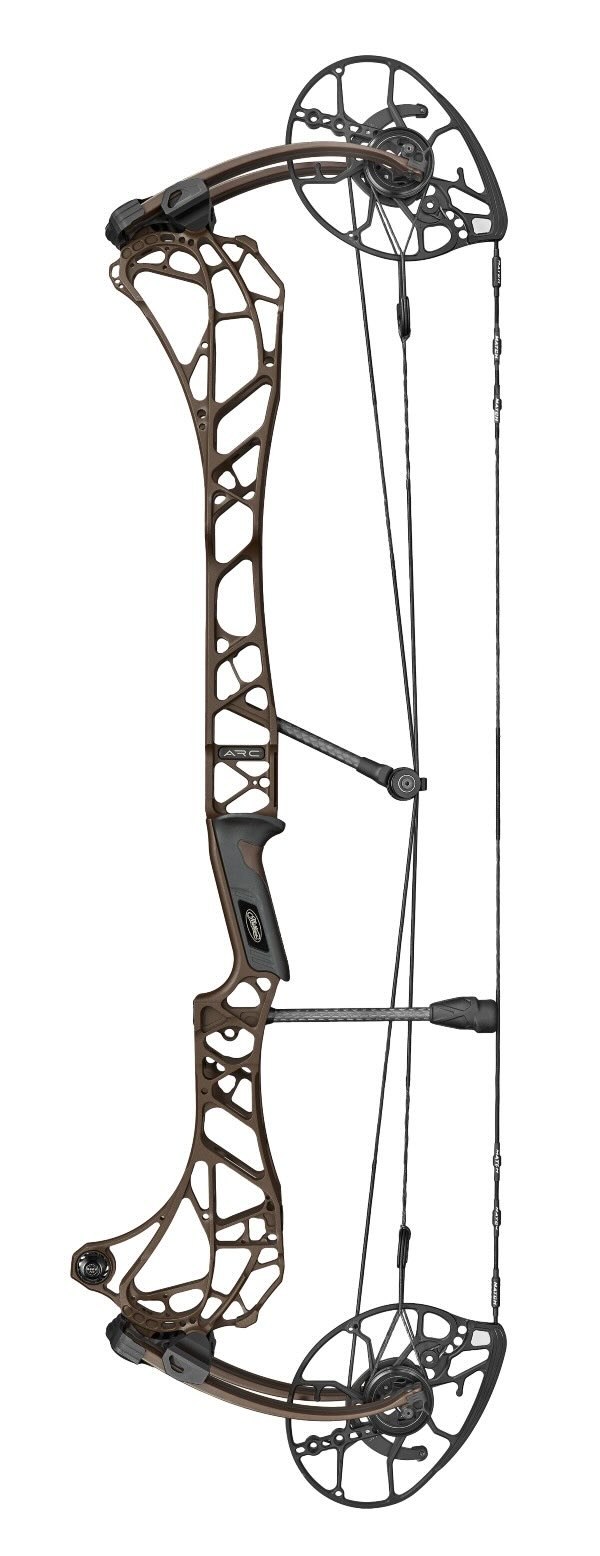
Sidebar: Test Bow Specs
- Axle-to-Axle Length: 34 inches
- Brace Height: 6.5 inches
- Draw Length: 28 inches
- Draw Weight: 73.1 pounds
- Let-off: 80 or 85%
- Bow-only Weight: 4.3 pounds
- Accessorized Total Weight: 6.7 pounds (including sight, rest, stabilizer, side stabilizer and quiver)
- Velocity: 281 fps (with 468-grain Easton 6.5mm Acu-Carbon 340 arrow); 284 fps (with 456-grain CX Maxima Triad 350 arrow); 287 fps (with 441-grain Victory VAP SS 350 arrow); 306 fps (with 388-grain CX Predator 350 arrow)
- Kinetic Energy: 82.08 foot-pounds (Easton); 81.69 foot-pounds (CX); 80.68 foot-pounds (Victory); 80.69 foot-pounds (CX Predator)
- Test-Bow Finish: Kodiak Brown
- MSRP: $1,569.99
- Contact: mathewsinc.com
Key New Features
The first and most recognizable new feature we’ll discuss is the latest rendition of the Bridge-Lock Riser. Beefed up with considerably more geometry than the LIFT X’s riser, the ARC’s riser is the strongest piece of aluminum Mathews has ever created. Despite the stronger, beefier design, the mass weight difference between the LIFT X and the ARC is negligible, especially given the ARC’s longer axle-to-axle length. The ARC riser eliminates flex like never before, which makes the shot sequence completely vibration-free. All Mathews bows shoot nice and smooth, but this has to be the smoothest yet.
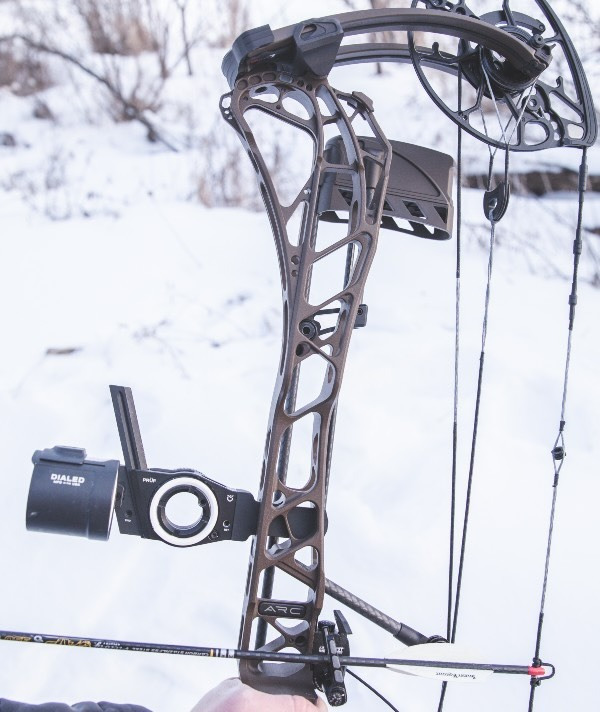
While we’re discussing the riser, it has two new integrated accessory mounts, which include the SCS cleat (no longer a bolt-on accessory) and the Bridge-Lock back-bar stabilizer mount. Combined with previous direct-mount accessory features, these two new details yield one of the cleanest, truly integrated and seamless bow builds money can buy. It’s not a bow and accessories. It’s a system, and it feels incredible.
Next, the entire mission behind the ARC was to achieve a system that maximizes accessorized speed. List velocities don’t account for peeps, D-loops or string silencers. Those vital components can rob at least several feet per second, so Mathews engineers focused on gaining that back.
One step in that direction was developing a new cam. The ARC debuts the latest SwitchWeight Cam, the SWX-2. It’s been years since a Mathews hunting bow has featured Perimeter Weighted Technology with an Inertia Disc, and the SWX-2 incorporates that detail to help retain velocity while maintaining the silky-smooth draw cycle that recent Mathews flagships have provided.

Engineers also revised the limb angle. The limbs come out of the pocket at a new angle, boosting velocity and efficiency. At the axle, the limbs are perfectly parallel rather than past parallel, which means the bow has zero jump at the shot. The limb pocket has also been minimized to reduce weight while boasting impeccable tolerances.
Regarding the SWX-2 Cam, there are two module options. Archers can utilize the standard SWX mods, but Mathews has also released the SWX-Z mods for this year. The Z mod has a gentler draw-force curve, and the net is a smoother draw cycle with a negligible velocity reduction. For bowhunters who demand all-out smoothness, this Z mod is the ticket, and the cool part is it’s compatible with the LIFT, LIFT X and ARC.
Finally, let’s discuss the latest rendition of the Mathews Bridge-Lock Stabilizer, which can be installed straight out from the bow or at a new seven-degree downward angle, positioning the weight lower and helping to anchor the bow for even better stability. Combined with the Harmonic Stabilizer and the Integrated Bridge-Lock V-Bar, this stabilization setup creates unreal stability and comfort at full draw.
Limb Shift
Last year, Mathews transitioned from the Top Hats spacer tuning system to the Limb Shift Technology, which is a bow press-free tuning feature that requires merely two hex wrenches. It’s unique to the market’s other designs in that it ties the cam to one limb, while the opposite limb can be adjusted in or out to correct a right or left tear. All you have to do is remove the lock screws to put the bow into tuning mode. The good thing is the bow is safe to shoot with those screws removed, leaving the adjustment screw exposed for easy access while you’re at the paper-tuner.
Last year, I honestly didn’t have to touch Limb Shift on the LIFT X because it tuned perfectly right from the factory and stayed put all year. Once I set up the ARC, my nock tore about 1 inch to the right of my point. I made a couple of small micro-adjustments to the Limb Shift feature and had the most perfect paper tear possible in a few minutes. This is a phenomenal tuning system and incredibly user-friendly, complete with etched reference marks to track adjustments. Tops Hats served their purpose, but Limb Shift is by far superior.

RPD Limbs, BOND Grip and MATCH Bowstrings
Just like the LIFT X, the ARC features Resistance Phase Damping (RPD), which utilizes four different limb pairs (eight limbs total) per bow. Silencing rubber is sandwiched between each limb pair, effectively thwarting vibrations before they begin, and the net is an unfathomably smooth shot. The limbs are also armored for the ultimate durability that laughs in the face of punishing landscapes.
The BOND Grip System is also back this year. The Engage model comes standard on the ARC, and there are Contour and Taper models, not to mention BOND Side Plates, to cater to different preferences. The BOND Grip is also compatible with the Mathews Shot Sense Module, which can help the archer track and identify shooting tendencies, informing where there is room for improvement. BOND one-piece grips also feature a snazzy textured and colored inlay, which adds style and provides just enough hand traction.
MATCH Bowstrings have been standard on Mathews bows since the LIFT, and they continue to exceed expectations. Before MATCH, I used to remove the stock set and replace it with a custom set. But with MATCH, my bows have held their tune all year, and I’ve experienced zero stretch, serving separations, or peep-alignment issues. It’s a great set, as it should be when we’re talking about a $1,569 bow.

Final Thoughts
My ARC 34 with 75-pound modules draws smoother than butter. According to my Last Chance Archery Bow Scale, it comes up 1.9 pounds shy of 75, but that’s nothing. Drawing and letting down is unexplainably smooth. The draw cycle is outstanding, and that’s with the standard module, not the smoother Z mod I mentioned earlier.
Stability is to be expected with a 34-inch-axle-to-axle bow, but the ARC 34 redefines it. If I were going to a TAC event or hunting caribou where shots are likely to be beyond 60 yards, I’d be thrilled to have the ARC 34 in hand. It is rock-steady in every sense of the term.
Given the astounding stability and the perfect tune via Limb Shift Technology, it’s no surprise that the ARC 34 is pinpoint accurate. I did a good amount of shooting in the cold and blowing Wisconsin winter conditions at various distances, and it just flat-out puts arrows where the pin is. I can’t wait until it warms up and I can stretch it out to well over 100 yards. As accurate as my LIFT X 29.5 was at those extended distances, I’ve seen enough to believe the ARC 34 will be even better.
I am a firm believer in string silencers, but unlike previous Mathews models, the ARC doesn’t come with them. The cool part is that, to my trained ear, it shoots as quietly as the LIFT X but without Monkey Tails, which can rob a few feet per second. It’s so quiet I don’t think I’ll be installing Monkey Tails, and that is the first time in 25 years of bowhunting. I really don’t believe it needs them.
One final note to wrap this thing up: The ARC 34 is a “big” bow for folks who’ve previously shot 30-inch-and-shorter bows. As I’m sure you know, there is an ARC 30, which will be the bestseller and appeal to more bowhunters. But for maximum stability, the 34 is the bow to beat in 2026.
Additional Notes: The Mathews ARC 34 was set up using a Last Chance Archery EZ Green Bow Press and EZ Green Bow Vise, and the draw weight was calculated using Last Chance Archery’s Digital Bow Scale. A Caldwell Ballistic Precision Chronograph measured the arrow velocities. Other products used were Easton’s Nock and D-Loop Pliers and Pro Hex Fold-Up Allen Set. Arrows were weighed on Last Chance Archery’s Pro Grain Scale.
In-the-field photos by Becca McDougal