
As I sat down to write this article, I couldn’t help but recall the many do-dads and trends I’ve seen over the course of my archery and bowhunting career. Of course, most of them have fizzled. But just for fun, let’s reminisce on a few.
Remember string trackers? How about overdraw rests? Oh, and let’s not forget the speed race, when many bow manufacturers competed for the highest velocity. I could go on, but the point is that trends rise and fall, which naturally reminds bowhunters that the middle lane is often where they best harmonize with their equipment.
As with most product categories, arrows have had trends, too. From cresting to arrow wraps to four- and six-vane arrows, I can remember a handful of popular waves. The biggest one right now has to do with arrow weight, and that’s what this article is about. Misinformation is being spewed online and elsewhere, and it is confusing some unknowing consumers about what their arrow weight should be. And this isn’t a new thing.
Past and Present Arrow Trends
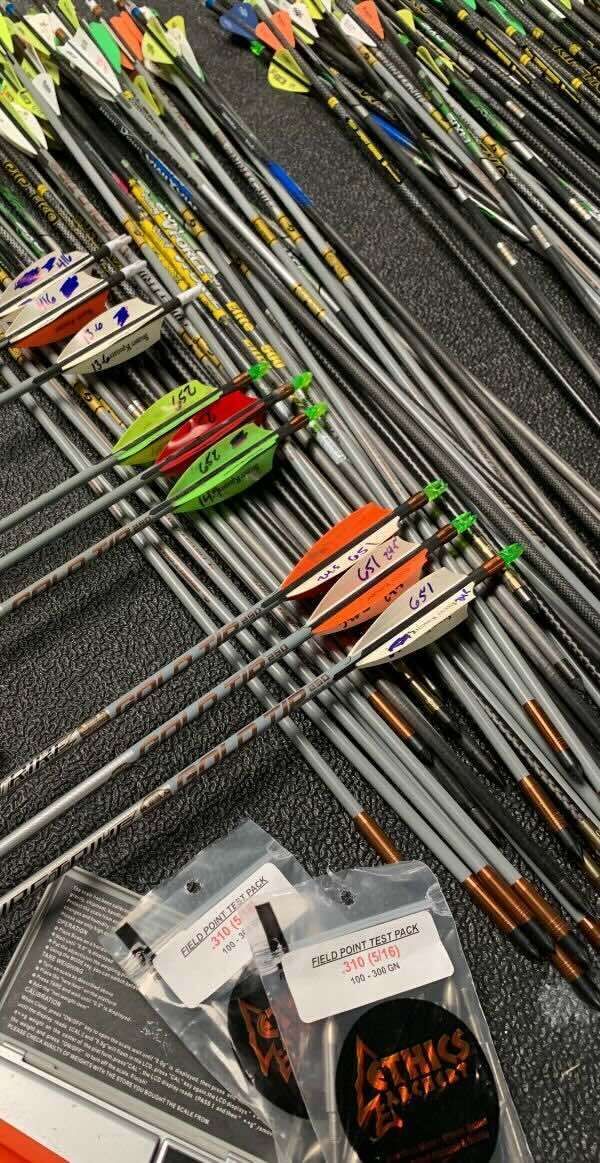
Rewinding to the mid-2000s, when I was in archery retail, most bow companies were chasing velocity. Around that same time, lightweight arrows that maximized bow speeds were pretty hot. Some folks were shooting dangerously light arrows. I specifically recall a competing dealer selling his customers a speed bow and under-spined arrows to show his customers outstanding velocities. It was not only dangerous but a detriment to bow performance. A small handful of archery consumers are still caught in the lie, but most have come to their senses.
More recently, some influencers began pushing an opposite agenda. Even though countless bowhunters have killed elk, moose and even brown bears with 500-grain arrows (or lighter), we were suddenly told that we needed arrows in the 500- to 650-plus-grain range for bowhunting whitetails. Of course, those of us who’ve been bowhunting for decades didn’t blink. Long before this agenda grew legs, most of us tech-savvy bowhunters had already done loads of testing with different arrow combinations and found the ideal combination of accuracy, trajectory and kinetic energy.
As a dealer, you have likely done your own testing and know the anatomy of a “normal” arrow setup, one that equalizes accuracy, trajectory and energy. Some of your customers, however, are likely confused by misinformation they’ve consumed via YouTube. And they’ll likely come in saying, “So-and-so said this or that.” Without disrespecting any influencers, carefully set the record straight so you can ultimately sell arrows to them that optimize rather than tank their bow’s performance. Here are some talking points for that discussion.
Light Arrows
Ultralight arrows are great for one thing: velocity. The byproduct of velocity is a flatter trajectory. This means tighter pin gaps and more forgiveness when estimating the yardage to an animal. Light arrows, however, neglect other important priorities. Here’s one example.
Another bowhunter and I once went fall turkey hunting. He was pulling 70 pounds but shooting a lightweight arrow with a 75-grain tip. He shot a gobbler at 30 yards and struck the wing butt. His shot placement was there, but his arrow literally bounced back out of the bird after breaking the wing bone. Thankfully, the bird was recovered, but follow-up was required. A turkey should never stop an arrow shot from a 70-pound bow. I believe the non-lethal results were due to the combination of a lightweight arrow and a lack of front of center (FOC). The arrow lost its energy immediately upon impact.
Additional negatives of ultralight arrows are that the bow will shoot louder, and crosswinds will have a greater impact on flight. Going as light as possible forsakes a lot of common sense. Now, let’s discuss the other end of the spectrum.
Heavy Arrows
Regarding the current trend I mentioned earlier, again, some people are advocating for 500- to 650-plus-grain arrows as “standard” bowhunting arrows for deer. Heavy arrows can certainly penetrate very well. But keep in mind that performance plateaus at a certain arrow weight, and then you begin to lose more performance than you gain. Joel Maxfield of Mathews Archery, who has a North American Super Slam under his belt and has arrowed hundreds of other critters around the world, shared how this might look.
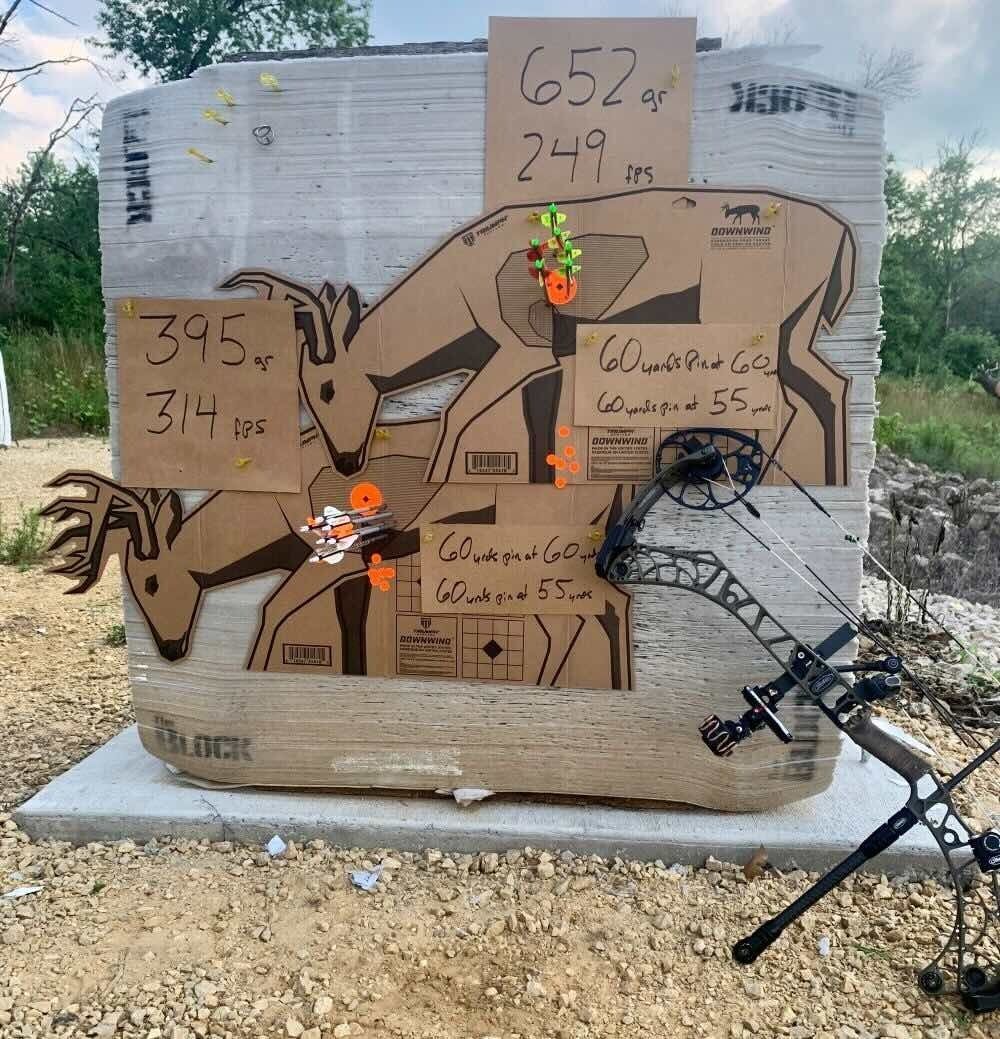
“I did an entire summer’s worth of arrow testing,” he said. “I documented the differences between a 400-grain arrow and a 600-grain arrow. The 600-grain arrow gained only 3 percent in energy but lost 27 percent in trajectory. Way more performance was lost than gained. Imagine the huge pin gaps all for a pathetic 3 percent energy gain. It isn’t worth it at all.”
Along the lines of heavy arrows is the discussion about an arrow’s front of center (FOC). Like overall arrow weight, FOC has a sweet spot. One summer, I was shooting Victory arrows with heavy stainless-steel inserts. They were flying well, but I wondered if going from a 100-grain tip to a 125-grain tip would boost penetration. I’ll tell you, my pin gaps got ridiculously wide, and so did my groups, all for almost no increase in penetration. I put my 100-grain tips back on and reset everything back where it was. In other words, don’t fuss with what works.
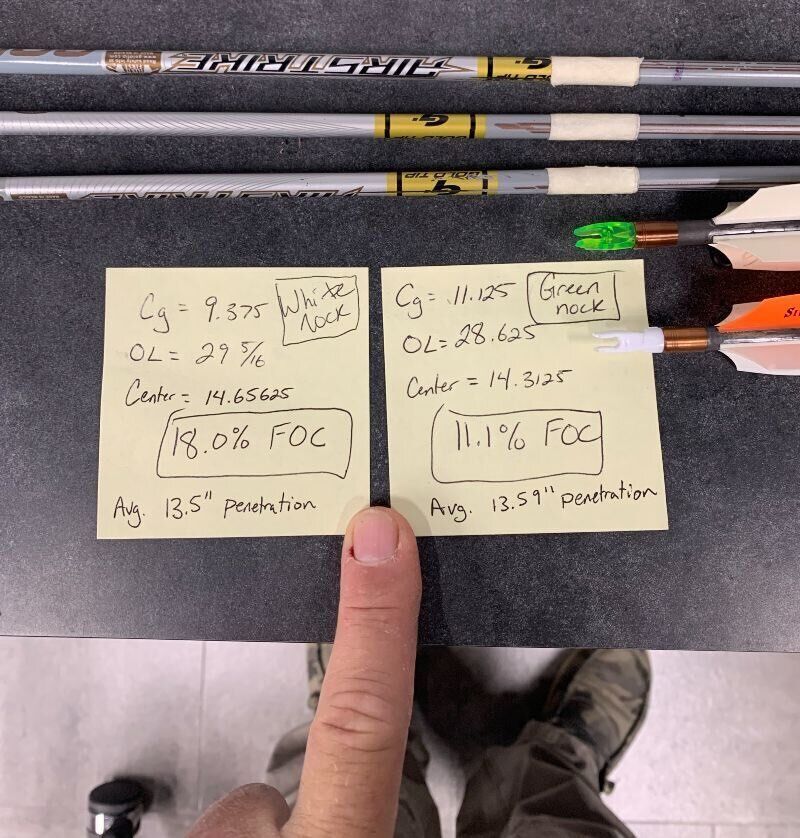
As with arrow weight, FOC has a sweet spot. As a general rule of thumb, an FOC percentage of about 10-15% optimizes flight and penetration. I generally build my arrows around 13% for deer and elk, and I’ve had excellent flight and penetration.
Finding Normal
So far, we’ve discussed light and heavy arrows, and now it’s time to find the middle ground where accuracy, trajectory and penetration unite. Through tireless testing, Maxfield has landed on some real numbers that can inform arrow builds.
“Stronger bow setups produce the best combination of accuracy, trajectory and penetration at 6.2-7.2 grains per pound of draw weight,” he explained. “With a 70-pound bow, you’re looking at 434-504 grains. That’s a ‘normal’ arrow weight that will perform on any North American animal.”
While he still tests heavier arrows, Maxfield continually finds that arrows in what he calls the “normal” weight range tune best and optimize accuracy. In other words, if a 430-grain arrow performs best from his current setup, he’ll shoot it at any North American big game animal with nothing but confidence.
"I don’t suggest building arrows to meet a specific weight threshold,” he said. “I build arrow setups that optimize accuracy and performance. Those are the most important things.
“Most less-powerful kids’ and women’s setups perform best with arrows at around 7.2 grains per pound of draw weight. With a 50-pound bow, 25-inch draw length and 340- to 350-grain arrows, my wife, Janice, has taken bears, whitetails, bull moose, African game and New Zealand game. And she shoots Rage 2-inch mechanical broadheads. Never has she hit an animal well that we didn’t recover. It just works.”
With youth and women’s setups at or near 30 pounds, Maxfield mentioned that his 6.2- to 7.2-grain reference yields too light an arrow for responsible bowhunting. “That arrow just won’t penetrate well. I don’t suggest shooting less than 300 grains from setups like that.”
Accuracy First
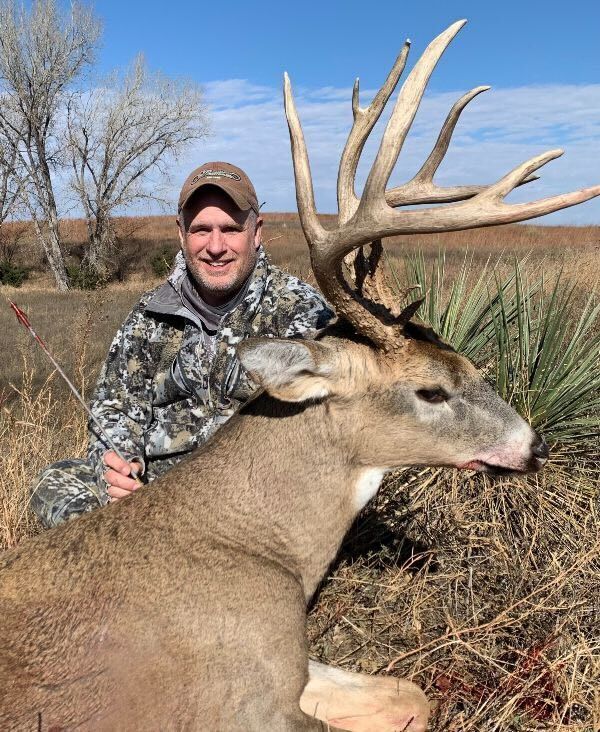
In talking with other hunters, I can’t count how many times equipment was blamed for unrecovered animals. Maxfield has witnessed more than a thousand bow kills, and not once was an animal hit well and not recovered. A friend of his shot a bull elk a few years ago from about 60 yards with a 380-grain arrow tipped with a 2.5-inch Rage Hypodermic Trypan broadhead. Most wouldn’t consider it an “elk arrow,” and even Maxfield said he probably wouldn’t go that light, but the arrow achieved excellent penetration and even broke the opposite shoulder. This hammers home this article’s chief takeaway, which is that arrow placement is the key, regardless of arrow weight.
In discussing this with your customers, focus heavily on the fact that shooting ultra-heavy arrows sacrifices more than it gains. An arrow in the “normal” weight range — Maxfield’s 6.2-7.2 grains per pound of draw weight — will optimize flight and tunability, keep your pin gaps reasonably tight, and provide all the penetration you need.
The ultra-heavy arrows are said to bust through bones as if they aren’t there. Although they can break bones in certain instances, Maxfield has seen heavy arrows shot from high-poundage bows stop upon impacting shoulders, so there’s no guarantee. The other thing is the people and groups pushing heavy arrows tend to talk about and focus on bones.
As we conclude, inform your customers that aiming for the shoulder is bad business, no matter what arrow they’re shooting. “The best place to aim is the center of the lungs,” Maxfield said. “It’s more forgiving if your arrow hits a few inches off. If you aim tight to the leg and hit too far forward, it’s nothing but bone, and even the heaviest arrows aren’t guaranteed to penetrate.”
Maxfield concluded our arrow conversation with a unique train of thought. “When any archery fails, any archery fails,” he said. “In other words, if my wife hits the shoulder blade with her setup, it doesn’t work, and if I do, it probably won’t work either. It’s really as simple as putting your arrow in the correct place. I’ve never seen an arrow fail to perform when an animal was hit correctly.”
Sidebar: Dangerous Game Arrows Simplified
Dangerous game animals typically warrant heavier arrow builds. People tend to complicate this process and aim for a certain weight threshold. Maxfield explained a stupid-simple process for creating a dangerous game setup, which he used when rigging up for Asian water buffalo in Argentina.
“My regular setup for deer and elk shoots 292 fps,” he said. “I put heavier SwitchWeight Mods on my Mathews, which increased the draw weight to 87 pounds. I built new arrows that weighed around 590 grains, which is approximately 6.8 grains per pound of draw weight, just like I recommend for virtually any game. The setup put my velocity right back at 292 fps. My sight tape and pins all stayed the same. It was like shooting the same setup as a 70-pound bow with a 450-grain arrow, but with a big kinetic energy boost.”
Did his arrow perform? Flawlessly. He shot his bull from 58 yards, and his 590-grain arrow, tipped with an Iron Will head, passed completely through the bull. The huge animal charged out to 90 yards and stopped. The bull was hit perfectly, but when a buffalo stops, you shoot it again. Maxfield grabbed a second arrow, this one tipped with a G5 Outdoors T2 rear-deploying mechanical broadhead, and it also hit perfectly, burying to the fletching. A third arrow with a G5 T2 passed through from 32 yards. Do you need an 800-grain arrow to penetrate a huge buffalo? Obviously not. And had Maxfield been launching 800-grain arrows, he certainly wouldn’t have had enough sight tape to dial out to 90 yards for his second shot.