
Trail camera technology has come full circle several times since I began using trail cameras about 25 years ago. Back then, while dropping off 35mm rolls to be developed at Walgreens, who foresaw that trail cameras would one day transmit data to a phone in real time? Comparing today’s most advanced models to the relics of the early 2000s is mind-blowing.
Of course, this product category’s perpetual advancement and the countless SKUs falling from the sky like Tetris blocks inevitably create a level of retail chaos. There are so many cameras and so many retailers (online and brick-and-mortar) selling them. In the time it took me to write the last two sentences, I could have easily bought a slew of cheap cameras on Amazon. With the market so saturated and every retailer competing for the lowest prices, how can you get a sliver of the pie when it feels like there’s hardly a crumb?
Recently, I discussed selling trail cameras in an archery pro shop with Mark Cuddeback of Cuddeback and Justin Gaiche of Chase Outdoors in Rothschild, Wisconsin. Digesting insights from both the manufacturer's and the dealer's perspectives should be enlightening, especially if this product category intimidates you or you’ve previously had minimal success with it. Here are some highlights from the discussion.
Understanding the Landscape
Let’s begin by identifying some trends. Mark Cuddeback has long been in the trail cam business and has a finger on the pulse regarding the average price of a trail camera sold today. He believes it is between $100 and $130. Gaiche concurred, holding that $120 is the average spent on a single cellular trail camera, while $30-$50 models dominate the conventional or non-cellular category.
That being said, the demand for non-cellular scouting cameras has scaled back. People still buy them, but our instant-gratification culture demands the convenience and advantages of receiving images and videos on phones. Even though cellular cameras are more expensive than conventional trail cameras, they’re still highly affordable to the average consumer. However, the data plans can become a big pill to swallow.
“We’re hearing that people are frustrated with paying, let’s say, $1,000 annually for cellular plans,” Cuddeback mentioned. “People want cell cameras, but they’re sick of the expensive plans. Our CuddeLink system solves that; users can connect up to 24 cameras with one plan. CuddeLink cameras cost a little more up front, but the user saves big on the plan fees.”
Chase Outdoors sells Cuddeback, Tactacam and WiseEye cameras, and Gaiche mentioned some buying tendencies he’s noticed.
“There are two vastly different camps,” he explained. “There are public land hunters who buy really cheap trail cameras because they’re concerned about theft or bear damage. Then there are the guys who have private land and demand better wireless cameras to minimize hunting pressure on their land. As a landowner myself, I value the CuddeLink system a lot. On 40 acres, it’s so easy to bump deer. But I can get all of my images and videos from a home camera and pay just one data plan fee. Customers also see the value, and for that reason, the CuddeLink system is a big seller.
“As far as a standalone cellular trail camera, Tactacam is enormously popular. In my opinion, Tactacam became popular because its cameras are great. Users love the way they work, and the technology, and the word spreads really fast. Having the wind direction, temperature, barometric pressure, moon phase and sunrise and sunset details on the picture really helps hunters peg consistencies and dial in on when to hunt a particular animal. The other standalone that is really solid and affordable is the Cuddeback Tracks.”
Gaiche also said that the AI component of WiseEye trail cameras, which can filter images to show only bucks, turkey or bears, for example, is gaining traction and will likely continue given the technological wave we’re on.

Your Merchandise Is Your Reputation
Now that you have a glimpse into some of the current trends and tendencies, it’s time to stock your shelves. But with countless brands to choose from, perhaps you’re perplexed. Don’t worry! Let’s bring some clarity to the matter.
“Over the years, we’ve constantly heard that users are frustrated by how a lot of trail cameras don’t last very long,” Cuddeback said. “Users commonly have trouble with their cameras, or they quit working within one or two years. They saved money up front by purchasing a cheap camera, but then had to turn right around and replace it. Cuddeback cameras usually last five years or longer. Many consumers don’t consider this when buying cameras. They don’t buy the cheapest bows or crossbows, but they often settle for cheap cameras. And then they complain when the cameras have trouble within a year or two. You get what you pay for.
“This raises an important point. Everything you sell reflects your reputation. If you sell a trail camera that fails in 18 months, it doesn’t just affect the trail camera portion of your business; it affects your entire reputation and trustworthiness. Think about it. If I can’t trust a dealer’s knowledge of trail cameras, how can I trust his knowledge about bows and broadheads? As a pro shop, always carry products that harmonize with your reputation.”
After using and selling the CuddeLink system for many years, Gaiche confirmed Cuddeback’s longevity claim.
“I’ve been using Cuddeback cameras for eight years now on my property,” he said. “They just keep going.”
Because quality is the focus at Chase Outdoors — it should be at every pro shop — Gaiche takes a DeWalt/Milwaukee approach to brand selection.
“Chase Outdoors has long been a two-brand store,” Gaiche said. “We recently added WiseEye because some customers who’re buying one or two standalone cameras want to buy something really good and different. The Wiseye processor alone is more expensive than an entire camera from some of the other brands, and the AI technology is outstanding. Anyway, I’ve stuck with Cuddeback and Tactacam for years, and now WiseEye. I want my staff to know the cameras we sell inside and out and be able to sell them. Trying to compete with large sporting goods stores by stocking a dozen brands is a race to the bottom.
“Another reason I like dealing with fewer brands is that the buying-trend needle hardly moves from season to season. That helps me more accurately forecast future sales, which informs ordering. With two or three brands, it’s also less likely that my unsold merchandise will be obsolete next season.”

Merchandising Tips
Because trail cameras make up such a competitive category, deciding how many units to have on hand can be perplexing. Mark Cuddeback shared one school of thought, while Gaiche explained a different angle that has worked for Chase Outdoors.
“CuddeBack cameras are virtually available on a ship-on-demand basis,” Cuddeback said. “We can usually ship the same day an order is placed. Of course, I suggest that dealers always have at least a handful in stock, but they can always re-order as needed and get more cameras within two business days, in most cases. You don’t have to be buried in inventory. You can have 10 or fewer cameras, but still react quickly to the consumer.”
Buying conservatively has merit, especially if your store and customer base are small. However, Gaiche explained that not having enough inventory could lead to missed sales.
“Our trail camera inventory is generally around 200 units,” he detailed. “I’ll explain why. I value every single customer, but I especially want to attract customers who live the hunting lifestyle 365 days a year. I’m talking about the people who buy pallets of treestands and dozens of trail cameras. If a customer like that wants to purchase 24 trail cameras, I'd better have that many to sell them. The saying is true that you can’t sell from an empty wagon. And when you have a system to sell like the CuddeLink system, customers are far more likely to buy quantities of cameras rather than one or two.”
Space is worth a premium in pro shops with limited square footage, which means you must make it count from a merchandising standpoint. In other words, make the trail cameras stand out without expending too much precious shelf space.
“We help dealers by making our product cartons attractive and informative,” Cuddeback explained. “Good placement combined with our detailed packaging works well for our dealers.”
Gaiche revealed his merchandising scheme. “I use colored wallpaper on my pegboards that match the brand,” he said. “That way, if I have a vacant spot, it doesn’t look like it. I have a custom lime green backdrop behind the Tactacams and a blue backdrop behind the Cuddebacks.”
Trail cameras and accessories are strategically placed at Chase Outdoors to encourage staff-to-customer interaction, which also yields higher sales.
“I have a 12-foot gondola space that faces directly at my archery counter,” Gaiche said. “There is a technical piece to selling cameras. Just like tree saddles, most customers want to have a conversation about trail cameras before buying. With this placement, my employees are right there to field questions and concerns.”
Go Above and Beyond
As far as getting your piece of the sales pie, the biggest thing a pro shop staff can do beyond selling better-grade trail cameras is stand behind them.
“Customer service will set you apart,” Cuddeback assured. “Understand the product, use it yourself, and be able to answer questions. Customers can buy hunting equipment anywhere, but they go to pro shops because they want expert knowledge. A dealer that provides expertise and good service before, during and after the sale is likely to have great success.”
Gaiche explained that the ability to service cameras by replacing parts can also set you apart. Few large sporting goods retailers can match that.
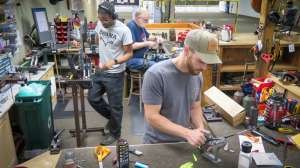
“If the batteries leak in a Cuddeback camera, I can replace the back of the camera for $20,” he said. “I stock the antennas and sensory lenses and can replace those when customers need them. I have Tactacam spare parts in stock, too. My staff can help customers with CuddeBack firmware updates, if necessary. The serviceability positions us to provide above-and-beyond service that the customer will value and remember.”

Sidebar: Offer the Possibles
Accessories. Every trail camera needs them, but how heavy should you order, knowing that customers might buy their batteries and SD cards from department stores?
“A four-foot section of my trail camera display is dedicated to accessories,” Gaiche said. “And then we keep the replacement parts behind the counter and make sure customers are aware that we stock them.
“As far as quantities, I have a POS system that provides sales-history insights. That certainly helps. Yes, a good POS system requires money and significant attention to detail, but it certainly has its benefits, especially in this category.”
Accessories also give the dealer more opportunities to win the customer’s favor.
“Let’s say a guy with 300 acres comes in and wants to buy 24 cameras complete with accessories, including batteries, solar panels and mounts,” Gaiche said. “I’ll unpackage the cameras, install batteries and SD cards, name and number each camera, and do the firmware updates. With Cuddeback, being able to sell all of those pieces with the camera allows me to make a good margin, whereas some of the other cameras are less profitable. And, I can deliver a level of service that is memorable and valuable to the customer.”