
Picture a well-geared bowhunter in your mind. For most of us, that person is dressed head-to-toe in some eye-catching brand of popular camouflage. Few would argue that camo and bowhunting are virtually synonymous. Yet the irony is that while many archery pro shops consider camo apparel an integral part of their product mix, many more believe stocking such gear simply doesn’t make good business sense.
On which side of the fence is your shop? We spoke recently with several pro shops to find the challenges of stocking premium apparel in today’s changing market, and uncover some tips and tricks that can help pro-camo shops make the most of their apparel sales.
Challenges Abound
“Apparel trends come and go,” said Brian Waldvogel, 41, manager of J’s Archery, a 24,000-square-foot shop with 12,000 feet of retail space based in Antigo, Wisconsin. “When we first started, our customer base wasn’t the Sitkas or First Lites. We’re located in northern Wisconsin; this area is conservative, we don’t have a lot of high-dollar metropolitan jobs and so introducing high-dollar premium gear doesn’t often go over very well.
“When we started back in 2010, the previous owner had a good relationship with Predator camo, and so we continued that for a bit, and Scent-Lok was also fairly popular back then. Then the carbon-based stuff kind of faded out, and some other stuff was starting to gain traction.
“Our customers were also venturing out West, and so at that point, we started with First Lite, selling mostly base layers, and got a little bit of traction with that. Then First Lite came back and said they wanted us to pre-book our stuff out, and asked for a little more (investment). Then about six years ago they went to direct sales, and so that went away.
“With Sitka, we first spoke with them at ATA several years ago; back then it was a $5K buy-in. And then 4-5 years ago, we did the buy-in, and it was $20K minimum. That’s a lot of overhead. But you turn it. We saw the growth of it, but then one day about a year and a half ago they called us and told us we’re not a dealer any more. They didn’t even give us an option. We talked to another dealer who got a similar phone call, and they were told they needed to make a $50K order that very same day, or they had to give up their dealership. Smaller dealers like us are sick of getting pushed around like that.
“And another adverse part of that is, what do your customers think? For a couple years you’ve been saying this one brand is the best thing ever, and a few years later, you’re saying a different brand is the best thing ever. It can be frustrating.”
A Good Move For All? It Depends
John Schaffer runs Schaffer Performance Archery in Burnsville, Minnesota, and his pro shop — one of the most successful in the country — has taken a slightly different tack.
“We don't currently stock any clothing in the store, and it’s for a couple reasons,” Schaffer said. “We’ve tried different brands over the years, and never had success with it. Being in the Minneapolis area, we’ve got quite a few big box stores around us that do a good job stocking that stuff. The other reason is, the big [camo] brands’ focus is now consumer-direct, and it kind of cuts the dealer out of it.
“I understand why they do it, and if I was in a smaller city with less competition, I might have a different opinion. But we’ve never found a way to make [selling apparel] work.
“I guess another thing is, being a specialized archery pro shop, when you walk into our shop you see very quickly that we sell bows, arrows and everything you can bolt to a bow. That’s it. Our specialty is very narrow, and it seems whenever we step outside that lane we don't do very well. Our strength, and specialty, is archery-specific stuff.”

Making Camo Work
Still another perspective comes from A-1 Archery, based in Hudson, Wisconsin. Owner/Manager Dan Ellyson says his shop’s apparel sales takes a lot of his time and focus, but in the end, equates to consistent sales and profits. And it also helps in attracting new customers through his door every year.
“We didn’t really get into clothing until about 2007, it was the first or second year of Sitka Gear,” Ellyson recalled. “The performance hunting clothes market was really non-existent at that time but we did Sitka for a year or two, and then didn’t carry it again for about 10 more years, but we’re again running Sitka today.
“If I was advising another pro shop on clothing, I would say when you’re in your infancy and trying to attract customers, trying to sell bows and build arrows, it’s very difficult to also bring in clothing and manage that all effectively. Clothing is one of those pieces of gear you see every day in your shop, and it doesn’t seem like it’s going to move very fast.
“Clothing can sit on the rack, it just doesn’t move as fast as your bows and accessories, and then you can end up running them at 40 or 50 percent off, just to get them out of your shop. And then the sales rep comes in and asks you if you want to do that all over again.”
When A-1 decided to get back into selling high-performance clothing circa 2014-15, it tapped First Lite, which was some unfortunate timing. Similar to J’s experience, 2 years later that company went consumer direct.
“We’d spent two years getting people behind it, which was frustrating,” Ellyson recalled. “And then 4-5 years ago we decided to get back into high-performance clothing, one of the reasons being, we had a very good sales rep.”
That particular Sitka rep, Ellyson explained, delivered the type of extensive shop education that he feels any shop must undertake to make the most of premium clothing sales. Ellyson considers such education step No. 1 of two critical steps.
“[The rep] came in and spent a lot of time with us to educate the staff, what to carry, when to carry it, he went through all the technical data, how to use it, what does it partner with. Our sales team felt pretty comfortable with that. We were educated not only on the salability, but where to display it in the shop, and other details we had been missing. He was good.”
For step No. 2, Ellyson feels any shop working with apparel needs a state-of-the-art point of sale (POS) system to be able to accurately track sales and inventory — to the day and dollar. Why? “Because apparel can get you into a lot of trouble, if you’re bringing in the wrong stuff, and doubling up on inventory that you still have.”
Ellyson further explained apparel inventory challenges.
“If I sell a bow, I’m going to set it up for that customer, and I just need to know the draw length and poundage. With performance hunting clothing — let’s use the Sitka Fanatic Jacket designed for extreme cold — we have to know what specific type of camo, which one of the specific sizes, and maybe pair it with a bib with the same options. Right there, if you were going to stock every one of them that they make, you’re going to have $3-$5K in just one item.
“Sitka builds in good margins for the dealer, but if it’s a warm fall, like it was in 2025, people are going to be buying the system below that. In 2025 we sold almost double the number of lighter-weight Stratus suits than we did the heavier Fanatic, and that’s unusual. We usually expect tremendous sales of the Fanatic because it’s simply the best Midwest jacket you can buy to keep you warm under 30 degrees, without doubt. But if you don't have very good inventory control, you could [mistakenly] double up on purchasing, and suddenly you have $12K of inventory in just one suit.
“For us, Sitka Gear, from a volume standpoint, it’s consistent, and some years are going to be better than others. As far as impact on your bottom line, in my opinion your premium apparel line should equal the third- or fourth-best bow brand in your shop.”

New Brands Emerge
A year and half ago, after being dropped by a premium camo manufacturer, J’s Archery was suddenly a shop without a camo line. But the shop has made a nice recovery, Waldvogel said, based on giving a couple newer brands a shot, one being Code of Silence wool apparel, and the other, TUO Gear, a newer premium camo brand.
“I absolutely love Code of Silence; dealing with the company is great, and the fit and finish of the clothing is coming around nicely,” Waldvogel said. “And with their newer River Wolf series, it seems like they’re really wanting to go after saddle hunters. I stock the lighter Flex Tec Series, and the heavier Dialed-In Series. For us up here, we’re talking cold weather, and so we sell more of the heavier Versa and Dialed-In series than anything. What’s nice is I wore the Sitka Fanatic, and I’m currently using the Code of Silence Dialed-In Parka, and I stay just as warm and it’s half the price.
“What we’re starting to see is customers getting into the brand via their cold-weather options, and then coming back for an early season Tec Series suit. So that’s promising.
“With TUO, I was told by the rep that it’s from ScentLok, so it appears they’re going after that premium market. So obviously ScentLok knows what they’re doing with apparel, which is good, and I’m going to keep that going. It wasn't a crazy big buy-in, and you could get premium pricing without a $5K, $10K or $15K buy-in.”
Using a POS System Smartly
To track every aspect of A-1’s apparel sales, Ellyson said his shop uses the ePRO POS system, which he highly recommends. Ellyson recalled the system cost $2,500 for initial setup and then $1,200 to $1,500 per year, all of which he said is well worth the efficiency it brings.
“I can quickly pull a report year over year, I can see how many specific items I’ve sold, how many I’ve purchased, and how many are in stock, and I could break it down further and see exactly when I sold them.”
Accurate sales numbers are important, Ellyson said, partly because of the timing of apparel buying.
“Because you have to purchase apparel so far in advance is why you have to pay attention, and use historical data to make smart purchases,” Ellyson said in late-January 2026. “As an example, I’ve already purchased our fall 2026 product; I purchased that in summer and early fall 2025. The key is, you run a few years of sales performance from your shop, and then, with help from a sales rep, you take all the data you’re collecting, and use that to place orders for next year.”
So how do you decipher all those numbers spit out by your POS system? Ellyson says there is at least one good standardized rule for stocking apparel.
“Really, your objective is to run out of product during your selling season, and to do that, I would roll with the ‘80-Percent Rule.’ That is, order 80 percent of what you have historically sold each year over a 2-year window. So take the average of the 2 years, and stock 80 percent of that number. And then, if you start running short, you can reorder if they have it in stock.”
In the end, Ellyson says your shop’s ability to move high-performance hunting apparel boils down to just two things: “Really, it comes down to how willing is your staff to get into the technical aspects of selling the clothing, and then, how well can you manage your inventory.”
Apparel Success Takes Commitment
That might sound simple and on some level it is, but Ellyson said newer shops should also keep another important detail in mind when it comes to apparel.
“You’re probably going to lose money on a clothing proposition for the first 2-3 years,” Ellyson warned. “You have to have that initial investment, and you should put any money you make back into your clothing stock. So if you sell it off that first year, you’re probably going to double your order, spend twice as much, and the profit that you make that first year will help fund that second year.
“You want to find what your company is capable of, and what you’re comfortable selling. And you might have to fund that again, until you find your ‘happy place’ — where you have the right mix of what you have to sell, and you learn how to sell it. Then you get into a nice rotation; it all looks good in your shop, and you learn how to sell it.”
Sidebar: Start with Headwear?
Thinking about dipping your toe into the apparel waters? A-1 Archery’s Dan Ellyson said it might be smart to start with something small, such as branded ball caps, before going great guns on a full line of premium hunting apparel. And that’s because apparel can be so challenging to manage.
“Currently we play in the Mathews- and Hoyt-branded clothing and hats, and we do well with it, it’s really consistent. We do really well with Mathews hats, we started focusing on that about 3 years ago, and that was one of the best things we did.”
Ellyson said that just like with his premium apparel sales, A-1’s use of an ePRO POS system has really helped maximize sales of branded hats and apparel.
“Before we got our POS system we didn’t really pay too much attention to our hat sales, and then you realize it can tell you everything you need to know: When to bring them in, how many to buy, when they sell.”
As an example, Ellyson offered the screen capture (below) of A-1’s ePRO sales report showing his year-over-year Mathews branded hat sales.
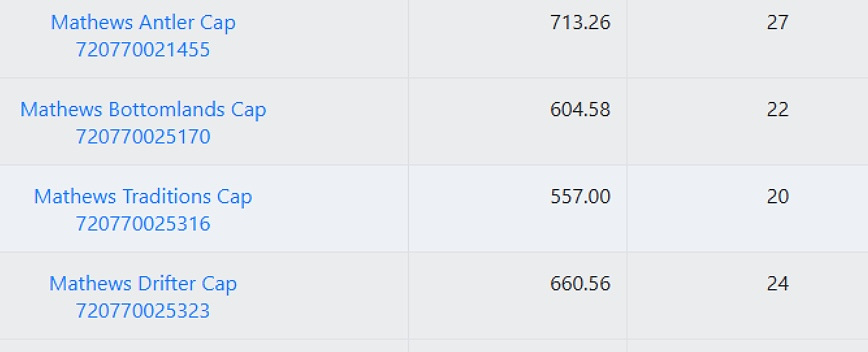
“It’s just amazing how many people buy a bow, and when waiting to check out throw one or two hats on the counter, too. Is it something all shops should be selling? I think that’s a really fair thing to say. Carry some hats, some branded T-shirts; those are fairly low-hanging fruit for pro shops.”